

Your website has brilliant content, a fast server, and dozens of quality backlinks, yet it’s stuck on page three of Google. What’s missing?
Most SEO professionals and content writers understand individual tactics but struggle to learn how on-page, off-page, and technical SEO function as an interconnected system. Search engines don’t evaluate these elements in isolation. They analyze them simultaneously, and weakness in any single area creates a ceiling for your entire ranking potential.
Without understanding how these three pillars of SEO work together, you’re optimizing in silos. You might fix technical issues without proper content, build backlinks to poorly structured pages, or create exceptional content that search engines can’t even crawl.
This guide breaks down exactly how each pillar functions mechanically within search engine systems, what role it plays in the ranking process, and most importantly, how these three components interconnect to determine which pages deserve top positions.
You’ll walk away with a framework for understanding why search engines rank sites the way they do, knowledge that transforms how you approach every SEO decision.
What Are the Three Pillars of SEO?
The three pillars of SEO represent distinct but interconnected categories that search engines use to evaluate websites: on-page SEO handles content optimization, off-page SEO builds authority, and technical SEO ensures infrastructure accessibility.
This framework didn’t emerge randomly. The SEO industry standardized on these three pillars because they mirror how search engines actually work. When Google’s crawlers encounter your site, they need to answer three fundamental questions:
- Can we access it? (Technical SEO)
- What is it about? (On-Page SEO)
- Should we trust it? (Off-Page SEO)
Each pillar addresses a different evaluation dimension.
On-page signals communicate relevance, telling search engines what topics your content covers.
Off-page signals establish authority, showing that others in your industry validate your expertise.
Technical signals ensure accessibility, proving that search engines can discover, crawl, and index your pages without barriers.
Here’s what makes this framework powerful: these pillars don’t operate independently. They form a holistic ecosystem where each component amplifies or limits the effectiveness of the others.
Three Pillars at a Glance
| Pillar | Primary Function | Key Focus Area | What It Tells Search Engines |
|---|---|---|---|
| On-Page SEO | Content Optimization | Relevance & User Experience | “This page answers queries about X topic” |
| Off-Page SEO | Authority Building | Trust & Validation | “Other authoritative sites endorse this content” |
| Technical SEO | Infrastructure | Accessibility & Performance | “We can crawl, index, and serve this page efficiently” |
Search engines evaluate all three simultaneously through algorithms containing 200+ ranking factors distributed across these categories. Strength in one pillar can’t compensate for critical weakness in another.
On-Page SEO: How Search Engines Read Your Content
On-page SEO contains everything directly within your website that communicates relevance to search engines and users. Think of it as language your pages speak to tell search engines, “Here’s what I’m about, and here’s why I’m the best answer for this query.”
When search engine crawlers land on your page, they parse your HTML like a detective analyzing evidence. They identify topics through keyword placement, understand content structure through header hierarchy, extract meaning from semantic relationships, and evaluate quality through depth and completeness.
What On-Page Elements Do Search Engines Analyze?
- Content quality and depth: Does the page thoroughly answer user intent? Does it provide unique insights or just shuffle existing information?
- Keyword integration: Primary and secondary keywords appear naturally in strategic locations, not stuffed artificially
- Title tags and meta descriptions: Your 60-character headline and 155-character summary that tell search engines (and users) what to expect
- Header structure (H1-H6): Logical hierarchy that organizes content and emphasizes important concepts
- URL structure: Clean, descriptive URLs that include target keywords when relevant
- Internal linking: Contextual links that help search engines understand site structure and topic relationships
- Image optimization: Alt text that describes visual content for accessibility and additional context
- Content freshness: Regular updates signal that information stays current and accurate
Search engines don’t just count keywords anymore. They understand context. Google’s RankBrain uses machine learning to grasp semantic relationships, user intent, and topic relevance even when exact keyword matches don’t exist.
Consider this example: A page about “automobile maintenance” can rank for “car repair tips” because search engines understand these concepts connect semantically.
They analyze entity relationships, identify synonyms, and evaluate whether your content satisfies the underlying search intent, not just whether it contains specific words.
The user experience dimension matters just as much as technical relevance signals. How you format content affects engagement metrics that feed back into rankings. Short paragraphs, bullet lists, multimedia integration, and clear navigation keep users on your page longer.
These behavioral signals: dwell time, bounce rate, and click-through rate tell search engines whether your content actually satisfies searchers.
On-page SEO isn’t about manipulating search engines with keyword density formulas. It’s about creating content so relevant, complete, and well-structured that search engines confidently recommend it to searchers.
Off-Page SEO: Building Digital Authority
Off-page SEO contains all external factors that signal authority, trustworthiness, and credibility to search engines. If on-page tells search engines what you’re about, off-page tells them whether they should believe you.
Here’s why this matters: search engines can’t rely solely on what websites say about themselves. Every site claims to be the best, most authoritative source. Search engines need external validation, proof that real users, industry experts, and other websites vouch for your content.
How Search Engines Measure Authority
The foundation of off-page SEO started with Google’s original innovation: PageRank. The algorithm treated links as “votes of confidence.” If authoritative sites linked to your page, you must be providing value.
While PageRank’s dominance has declined since Google’s early days, backlinks remain a critical ranking factor.
But modern off-page SEO extends far beyond link counting. Search engines now evaluate:
- Backlink quality: A single link from an authoritative, relevant site (think New York Times or industry leaders) carries more weight than hundreds of links from low-quality directories
- Link context and relevance: Links from pages topically related to yours signal stronger endorsement than random, unrelated links
- Anchor text diversity: The clickable text in links should vary naturally, over optimized anchor text triggers spam filters
- Brand mentions: Even unlinked mentions of your brand name across the web signal authority and awareness
- Online reviews and ratings: Particularly for local businesses, reviews on Google, Yelp, and industry platforms build trust signals
- Social media presence: While social signals aren’t direct ranking factors, they indicate brand strength and content shareability
- Digital PR and media coverage: Features in reputable publications establish expertise and thought leadership
Think of authority as a reputation score. Just like you trust restaurant recommendations from food critics more than anonymous internet reviews, search engines trust content endorsed by authoritative sources more than content without external validation.
Here’s the mechanism: When authoritative sites link to your page, they transfer “link equity” (sometimes called “link juice”). This authority flows through your site’s internal link structure, distributing value across connected pages.
That’s why your site architecture matters. It determines how external authority distributes throughout your domain.
Trust Evaluation Process
Search engines don’t just count links. They evaluate link quality through sophisticated analysis:
- Domain authority assessment: How authoritative is the linking site itself? Authority is recursive. Links from sites that have strong authority matter more
- Relevance matching: Does the linking page’s topic relate to your content? Contextual links signal genuine endorsement
- Link placement: Links in main content carry more weight than footer or sidebar links
- Traffic patterns: Do people actually click these links? Engagement signals validate that humans find the links valuable
Consumer behavior reinforces why off-page signals matter. Studies show over 90% of consumers check online reviews before visiting businesses. Search engines recognize this, and reputation management has become an indirect but significant ranking factor.
The authority pillar answers search engines’ fundamental question: “Why should we rank this page over competitors?” Your content might be relevant and accessible, but without external validation, search engines have no reason to trust you more than dozens of other sites covering the same topic.
Technical SEO: The Foundation Search Engines Build On
Technical SEO optimizes your website’s infrastructure so search engines can discover, crawl, index, and render your pages without barriers. It’s the unsexy foundation that makes everything else possible.
You can write the world’s best content and earn links from every major publication in your industry, but if search engines can’t properly crawl and index your pages, none of it matters. Technical SEO is the gatekeeper that determines whether search engines even see your site.
How Search Engines Access Your Content
Understanding technical SEO requires understanding three distinct processes search engines perform:
Crawling: Search engine bots (called spiders or crawlers) follow links across the web to discover pages. They respect robots.txt files that specify which areas you want them to avoid. They have limited crawl budget: time and resources allocated to crawling your site, so efficiency matters.
Indexing: Once crawled, search engines analyze and store your page data in massive databases (index). They determine which version of similar pages to index (canonicalization), filter out duplicate content, and decide whether pages merit index inclusion at all.
Rendering: Modern search engines execute JavaScript to see pages as users see them. Sites relying heavily on JavaScript frameworks need to ensure crawlers can render content properly. Otherwise, search engines see blank pages while users see rich content.
Critical Technical Elements
Technical SEO covers dozens of factors, but these core elements determine whether search engines can access and properly evaluate your site:
- Site speed and Core Web Vitals: Google confirmed these as direct ranking factors. Largest Contentful Paint (LCP), Interaction to Next Paint (INP), and Cumulative Layout Shift (CLS) measure loading performance, responsiveness, and visual stability
- Mobile friendliness: With 63% of all traffic from mobile devices, responsive design isn’t optional. It’s mandatory for ranking
- HTTPS security: Encrypted connections (padlock in browsers) signal trustworthiness and protect user data
- XML sitemaps: These files list your important pages, helping search engines discover content efficiently
- Structured data and schema markup: Code that explicitly tells search engines what your content represents: products, articles, FAQs, recipes, etc.
- Site architecture: Logical, hierarchical structure that keeps important pages within 3-4 clicks of your homepage
- Canonical tags: These specify the main version when you have similar or duplicate content across multiple URLs
- Redirect handling: 301 redirects pass authority when you move pages. 404 errors waste crawl budget and frustrate users
Why Technical SEO Scales Differently
Here’s what makes technical optimization unique: unlike on-page work that requires effort for every piece of content, technical improvements scale across your entire site once implemented correctly.
Fix your site speed once, and every page loads faster. Implement proper schema markup in your template, and every new article gets rich results eligibility automatically. Optimize your site architecture, and all future content benefits from better crawl efficiency.
| Aspect | Technical SEO | On-Page SEO |
|---|---|---|
| Focus | Infrastructure & accessibility | Content & relevance |
| Scope | Site-wide backend configuration | Individual page optimization |
| Visibility | Hidden from users (mostly) | Visible to users |
| Scalability | High (fix once, applies everywhere) | Lower (requires page-by-page work) |
| Skill Set | Developers, technical specialists | Writers, content strategists |
Think of technical SEO as building codes for houses. You can have beautiful interior design and prime real estate location, but if the foundation is cracked and the electrical system doesn’t meet code, the house won’t pass inspection.
Similarly, content and authority don’t matter if search engines can’t properly access and process your pages.
How Search Engines Combine All Three Pillars to Determine Rankings
Understanding this parallel evaluation process reveals why balanced optimization across all three areas matters so much.
The Ranking Process Explained
When you search for “best running shoes for beginners,” Google doesn’t first check technical SEO, then on-page, then off-page. Instead, the algorithm performs all three evaluations at once:
- Technical accessibility check: Can we crawl this page? Does it load quickly? Is it mobile-friendly? Does it have critical errors?
- Relevance assessment: Does this page actually answer the query? How comprehensively? Does it match search intent?
- Authority validation: Do other authoritative sites endorse this content? Does the domain have topical expertise?
- User experience evaluation: Do people who visit this page find it satisfying? Do they bounce immediately or engage with content?
- Freshness calculation: Is this information current? When was it last updated?
- Competitive comparison: How does this page stack up against the 1,000+ other pages targeting this query?
- Personalization adjustment: Based on this user’s location, search history, and preferences, is this result particularly relevant?
- SERP diversity consideration: If we’ve already shown similar results, should we diversify with different perspectives?
This process happens in milliseconds for billions of searches daily.
How Different Query Types Weight the Pillars
Not all queries weight the three pillars equally. Search engines adjust importance based on query type and user intent.
Informational queries (“how does photosynthesis work”): Heavily weight on-page content quality and comprehensiveness. Users want thorough, accurate explanations. Authority matters less for basic educational content.
Commercial queries (“best project management software”): Balance all three pillars. Content needs to cover options thoroughly (on-page), the site needs industry credibility (off-page), and comparison tables must render properly (technical).
Transactional queries (“buy Nike Air Max 90”): Weight technical factors and authority more heavily. Page speed matters for conversions. Established e-commerce authority signals trustworthiness for transactions.
Navigational queries (“Facebook login”): Prioritize technical accessibility and brand authority. Users want the official page, fast.
Top Ranking Factors Across All Pillars
Modern ranking uses 200+ factors, but research consistently identifies these as most influential:
| Ranking Factor | Pillar Category | Impact Level | What It Measures |
|---|---|---|---|
| Content quality & relevance | On-Page | Very High | Does this answer user intent comprehensively? |
| Backlink quality & quantity | Off-Page | High | Do authoritative sites vouch for this content? |
| Core Web Vitals | Technical | High | Does this page provide fast, stable user experience? |
| E-E-A-T signals | All Three | High | Experience, Expertise, Authoritativeness, Trust |
| Keyword optimization | On-Page | Medium-High | Does content target relevant search terms naturally? |
| Mobile-friendliness | Technical | Medium-High | Does this work on smartphones? |
| Site security (HTTPS) | Technical | Medium | Is connection encrypted and safe? |
| User engagement metrics | On-Page | Medium | Do users find this content satisfying? |
Since 2018, satisfying content has consistently ranked as the top factor, surpassing even backlinks. This shift reflects Google’s improving ability to evaluate content quality directly rather than relying primarily on external validation.
Machine learning plays an increasingly central role. RankBrain, one of Google’s three most important ranking signals, uses AI to understand context, evaluate user satisfaction, and adjust rankings based on how people interact with search results. The algorithm learns which pages best satisfy specific queries and adjusts rankings accordingly.
Why the Three Pillars Can’t Function in Isolation
The harmony between pillars creates a multiplicative effect rather than an additive one. This distinction matters a lot for your strategy.
Additive thinking says: “I have good technical SEO (score: 7/10), decent content (score: 6/10), and okay backlinks (score: 5/10). My overall SEO score is 18/30.” That’s not how it works.
Multiplicative thinking says: “My technical foundation (0.7) × content quality (0.6) × authority (0.5) = 0.21 overall effectiveness.” This model better represents reality, weakness in one pillar drastically limits the others.
How Balanced Strategies Create Success
Sites ranking in top positions consistently excel across all three dimensions. They’re not perfect in every aspect, perfection isn’t necessary, but they meet minimum thresholds in all three pillars and typically excel in at least two.
Successful SEO strategies audit all three areas, identify the weakest pillar, and allocate resources to strengthen that bottleneck. If your technical SEO is limiting crawlability, content improvements won’t help. If you have excellent infrastructure but thin content, link building won’t compensate.
The holistic approach treats the three pillars as an integrated ecosystem. Every optimization decision considers the interaction between pillars:
- Adding new content? Ensure technical infrastructure can handle more pages without sacrificing speed
- Building backlinks? Point them to your best, most optimized pages where authority will have maximum impact
- Implementing technical improvements? Prioritize changes that enhance both crawlability and user experience
This integrated thinking separates effective SEO strategies from scattered tactics that waste resources on isolated improvements.
Three Pillars in Modern Search
The three-pillar framework remains foundational, but how search engines evaluate each pillar evolves constantly with algorithm updates and technological advancements.
AI’s Impact on How Search Engines Evaluate Content
Machine learning transformed on-page evaluation. Google’s RankBrain, BERT, and MUM models understand content context, semantic relationships, and user intent beyond simple keyword matching.
RankBrain analyzes user behavior to determine which results best satisfy queries, then adjusts rankings based on engagement patterns. If users consistently prefer certain results, RankBrain learns those pages better match intent.
BERT understands natural language nuances, how prepositions and word order change meaning. Search engines can now grasp the difference between “how to install WordPress on a server” and “how to install a WordPress plugin”, subtle but important distinctions.
MUM (Multitask Unified Model) understands information across languages and formats. It can answer complex questions requiring synthesis from multiple sources.
These AI advancements mean search engines evaluate content quality, topical authority, and user satisfaction more accurately than ever. You can’t fool modern algorithms with thin content optimized for keywords. They recognize whether you actually answer queries completely.
What’s Constant: The Framework Endures
Algorithm updates come and go. Ranking factors shift in importance. Technical requirements evolve. But the fundamental questions search engines ask remain unchanged:
- Can we access this page? (Technical)
- What is it about? (On-Page)
- Should we trust it? (Off-Page)
The three pillars organize these questions into actionable frameworks. As long as search engines need to crawl, understand, and rank content, these categories will remain relevant for understanding SEO mechanics.
Your Next Steps
Ready to audit your own SEO strategy across the three pillars? Here’s where to start:
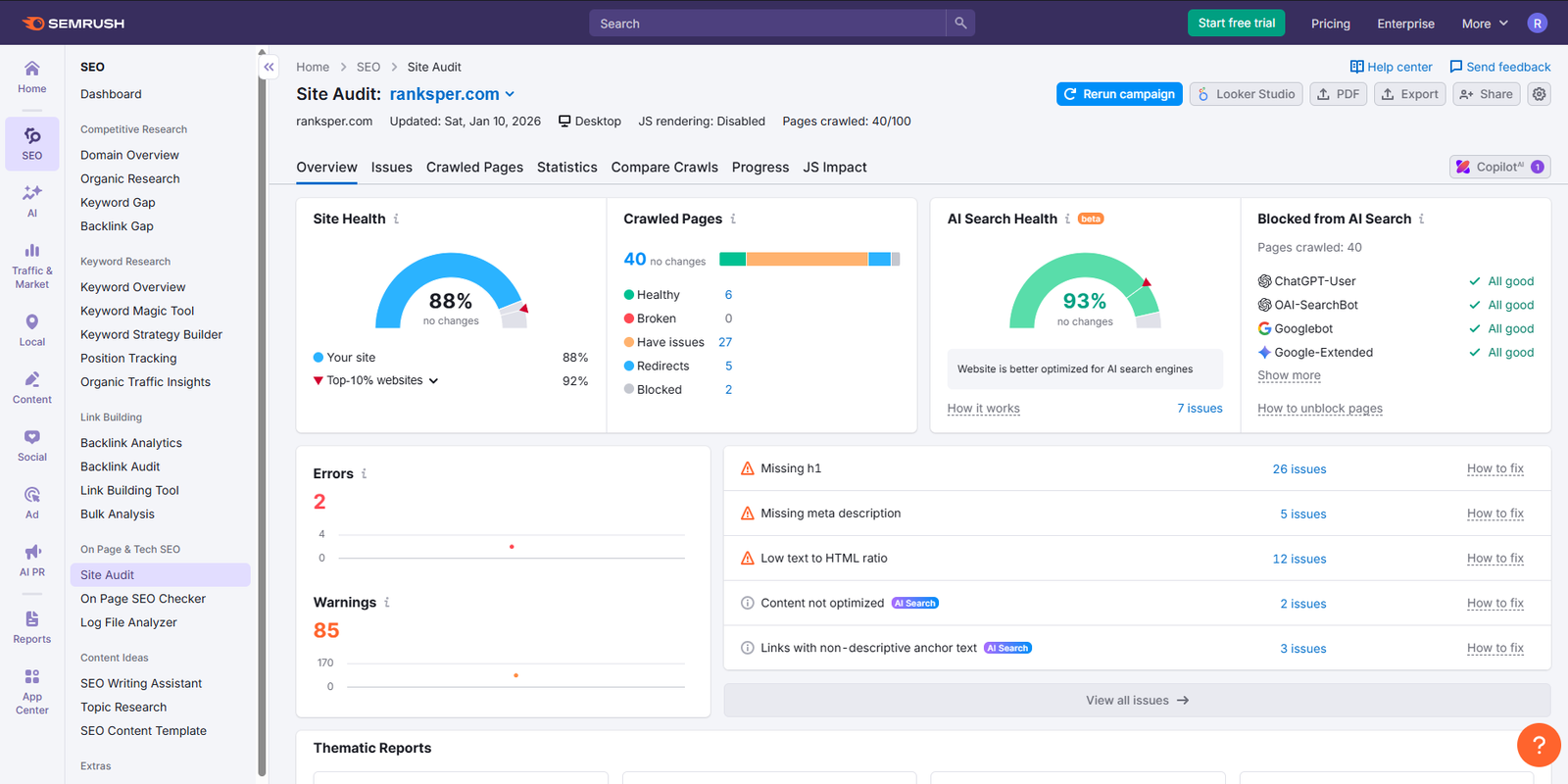
- Conduct an audit: Use tools like Google Search Console (technical), SEMrush or Ahrefs (on-page and off-page), and PageSpeed Insights (technical) to assess current performance in each category
- Identify your weakest pillar: Be honest about which area has the most critical gaps. That’s your bottleneck limiting overall performance
- Create a balanced action plan: Allocate resources across all three pillars proportionally, but prioritize strengthening your weakest area first
- Measure pillar specific metrics: Track crawl errors and Core Web Vitals (technical), keyword rankings and engagement (on-page), backlink growth and domain authority (off-page)
- Think systemically: Before implementing any optimization, consider how it affects all three pillars. Every decision has cross-pillar implications
When you learn how these pillars interconnect, you’ll stop chasing individual tactics and start orchestrating comprehensive strategies that satisfy both algorithms and users. That’s when SEO becomes less about gaming systems and more about creating genuinely valuable, accessible, authoritative content that deserves to rank.

