

Most marketing campaigns don’t fall apart at launch. They fall apart six weeks later, in the meeting where someone asks whether it worked, and the ad platform, Google Analytics, and the CRM each tell a different story. By then nothing can be fixed, because the decisions that make a campaign measurable were never made.
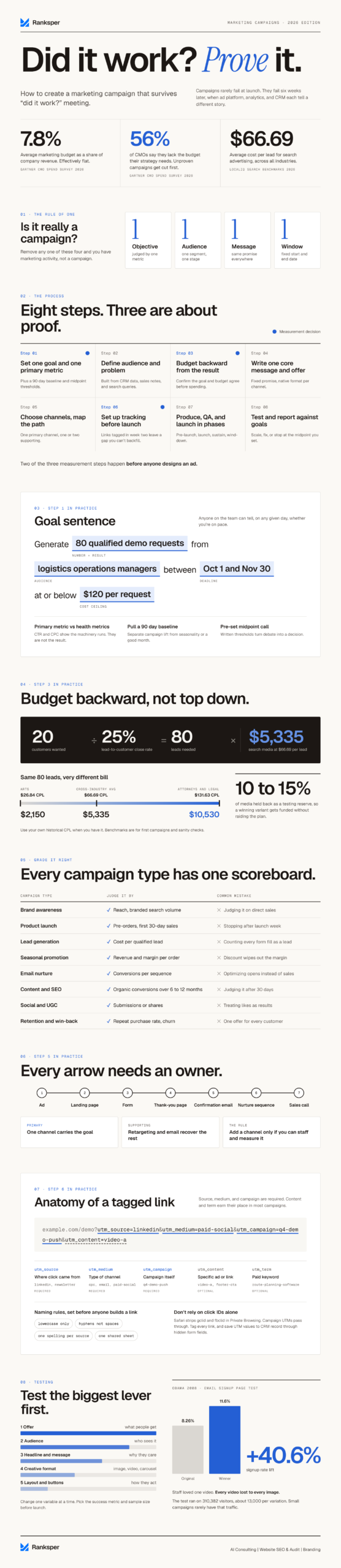
Here’s how to create a marketing campaign: set one goal and one primary metric, define your audience, budget backward from the result you need, write one core message and offer, choose channels and map the conversion path, set up tracking before launch, launch in phases, then test and report against the original goal.
That list looks like every other guide’s. The difference is the order: three of those eight steps are measurement decisions, and two of them happen before anyone designs an ad. That matters more in 2026 than it used to. Marketing budgets averaged 7.8% of company revenue in Gartner’s 2026 CMO Spend Survey, effectively flat, and 56% of CMOs said they lack the budget their strategy needs. A campaign that can’t show its return is an easy line to cut.
Below you’ll get each step in working detail, budget math built on 2026 search advertising benchmarks, a UTM convention you can copy, and four real campaigns broken down by the step they got right.
What is a marketing campaign?
A marketing campaign is a coordinated set of marketing activities, run across one or more channels for a fixed period, that moves a defined audience toward one measurable business goal. Unlike always-on marketing such as your blog, SEO, or social posting, a campaign has a start date, an end date, and a single objective that the effort is judged against.
It’s also broader than an advertising campaign, which covers paid placements only. A marketing campaign can combine ads with email, content, PR, events, and direct mail, all carrying the same message.
Here’s a quick test: a real campaign has one objective, one audience, one message, and a fixed window. Remove any of the four and you have marketing activity, not a campaign. Adobe calls the first part the “Rule of One,” and it’s the easiest rule to break when a launch tries to drive awareness, leads, and sales at once.
Types of marketing campaigns and the metric each should be judged by
Every guide lists campaign types. The more useful question is which metric each type should be judged by, because grading a campaign on the wrong number is how good campaigns get cancelled. Adobe’s framework makes the point directly: a brand awareness campaign shouldn’t be judged by immediate direct sales.
| Campaign type | Main goal | Primary metric | Common mistake |
|---|---|---|---|
| Brand awareness | Be known and remembered | Reach, branded search volume | Judging it on direct sales |
| Product launch | Create demand for a release | Pre-orders, first 30-day sales | Stopping promotion after launch week |
| Lead generation | Fill the sales pipeline | Cost per qualified lead | Counting every form fill as a lead |
| Seasonal or sales promotion | Short-term revenue | Revenue and margin per order | Discount wipes out the margin |
| Email nurture | Move leads toward purchase | Conversions per sequence | Optimizing opens instead of sales |
| Content and SEO | Compounding organic demand | Organic conversions over 6 to 12 months | Judging it after 30 days |
| Social and user-generated content | Social proof and participation | Submissions or shares | Treating likes as results |
| Retention and win-back | Keep or reactivate customers | Repeat purchase rate, churn | One offer for every customer |
Successful marketing campaigns often blend types, but each one still needs a single row it’s graded on. Pick it now, because it shapes every step below.
How to create a marketing campaign in 8 steps
- Set one goal and one primary metric.
- Define the audience segment and the problem you solve.
- Budget backward from the result you need.
- Write one core message and a clear offer.
- Choose channels and map the conversion path.
- Set up tracking before any asset ships.
- Produce assets, run QA, and launch in phases.
- Test, analyze, and report against the original goal.
Steps 1, 3, and 6 are where most “did it work?” arguments are born, so they get the most detail. Write down the output of each step and you have your marketing campaign planning brief.
Step 1: Set one goal and one primary metric
Start with the business outcome, then write it as one sentence with a number, an audience, a deadline, and a cost ceiling:
Generate NUMBER RESULTS from AUDIENCE between START DATE and END DATE,
at or below COST PER RESULT.
Say you sell route-planning software. A usable goal reads: “Generate 80 qualified demo requests from operations managers at regional logistics companies between October 1 and November 30, at or below $120 per request.” On any given day, anyone on the team can tell whether you’re on pace.
Then separate the primary metric from health metrics. Click-through rate, cost per click, and engagement tell you whether the machinery is running, but they aren’t the result. In LocaliQ’s 2026 search benchmark report, Amy Bishop, SVP of performance marketing at Waystar, describes CPC and CTR as health metrics to monitor rather than KPIs to chase.
Two more decisions belong here, before any creative exists. First, pull a baseline: the same metric for the previous 90 days, so you can separate campaign lift from seasonality or an ordinary good month. Second, set the midpoint numbers that mean scale, fix, or stop. Written down in advance, they turn the midpoint review into a decision instead of a debate.
Step 2: Define the audience segment and the problem you solve
Choose one segment you can describe in a sentence that someone outside marketing would understand, then note which buying stage they’re in. Someone who doesn’t know they have the problem needs a different message than someone comparing three vendors, and a campaign aimed at both usually lands with neither.
Build the profile from evidence, not a brainstorm. Adobe’s framework recommends grounding targeting in CRM history and site analytics rather than assumptions. The richest sources sit closest to customers: sales call notes, support tickets, reviews, and the exact phrases in your search query reports. For search channels, the query itself reveals the stage, which is why matching your message to search intent matters as much as the targeting settings. Write the problem down in the customer’s own words, because you’ll reuse that phrasing in the ad copy and the landing page headline.
Step 3: Budget backward from the result you need
Most budgets are set top-down: “we have $5,000, let’s see what it buys.” Work the other direction first, so you know whether the goal and the budget are even compatible:
Leads needed  = customers wanted ÷ lead-to-customer close rate
Media budget  = leads needed × expected cost per lead
Total budget  = media + creative + tools + people + testing reserve
Here’s a worked example. You want 20 new customers, and your sales team closes 25% of qualified leads, so you need 80 leads. LocaliQ’s 2026 data puts the average cost per lead for search advertising at $66.69 across industries, which makes the search media for 80 leads roughly $5,335.
Now look at the spread. The same report shows an average CPL of $26.84 for arts and entertainment and $131.63 for attorneys and legal services. Those 80 leads cost about $2,150 in one industry and $10,530 in another. Use your own historical CPL whenever you have it. Benchmarks are for first campaigns and sanity checks.
If the budget is fixed, run the formula in reverse: budget ÷ expected CPL = leads you can afford, multiplied by your close rate to get customers. If that misses the goal, change the goal, the channel, or the conversion rate now, not in week five. Either way, hold back 10 to 15% of media as a testing reserve, so you can fund a winning variant without raiding the rest of the plan.
Step 4: Write one core message and a clear offer
The core message is one sentence: the problem you solve, for whom, and why you’re the better answer. The offer is what the audience gets for acting during the campaign window, such as a trial, an audit, a demo, a guide, or a discount. A message without an offer builds interest nobody acts on. An offer without a message reads like a coupon.
Test the concept before producing anything. Show it to someone who wasn’t involved and ask what it makes them think. If their answer doesn’t match your one sentence, the concept isn’t finished.
Across channels, keep the promise fixed and let the format change. A six-second video, a search ad, and a nurture email should all make the same claim in their own native shape. Campaigns also borrow the brand’s voice and look, so if your brand identity isn’t documented, expect assets to drift. Multi-channel campaigns drift fastest.
Step 5: Choose channels and map the conversion path
Multi-channel marketing campaigns draw from four kinds of media, often called the PESO model®, created by Gini Dietrich. Paid media (search, social, display) buys reach on demand. Earned media (press, reviews) carries credibility you can’t buy or schedule. Shared media is social engagement. Owned media (your site, email list, blog) costs little and stays in your control.
The decision rule: one primary channel carries the goal, and one or two supporting channels feed it or recover what it misses (retargeting and email are the usual pair). Add a channel only if you can staff it for the whole run and measure it on its own. Every extra channel adds production work and splits the budget, and a channel that gets too little spend never produces enough data to judge.
Then map the path from first touch to conversion, one handoff at a time:
Ad → landing page → form → thank-you page → confirmation email → nurture sequence → sales call
Every arrow is a place where people drop out, and every arrow needs an owner. The landing page is where the ad’s promise either holds or breaks, so it deserves its own review. Our guide to landing pages that rank and convert covers what that page needs.
Step 6: Set up tracking before any asset ships
Tracking marketing campaigns only works if it’s built before launch, because links tagged in week two leave a gap you can never backfill. UTM parameters are the foundation. Google’s Analytics documentation says to always include utm_source, utm_medium, and utm_campaign when you tag a URL, and those values then appear in the Traffic acquisition report. Two optional parameters earn their place in most campaigns:
| Parameter | What it identifies | Example value |
|---|---|---|
| utm_source | Where the click came from | linkedin, newsletter |
| utm_medium | The type of channel | cpc, email, paid-social |
| utm_campaign | The campaign itself | q4-demo-push |
| utm_content | The specific ad or link | video-a, footer-cta |
| utm_term | The paid keyword | route-planning-software |
A tagged link looks like this:
https://example.com/demo?utm_source=linkedin&utm_medium=paid-social&utm_campaign=q4-demo-push&utm_content=video-a
Set naming rules before anyone builds a link, and keep them in one shared sheet. Use lowercase only, since reports list “Email” and “email” as separate values. Use hyphens instead of spaces, and agree on one spelling for every source and medium. Google notes that a standardized UTM structure also keeps traffic from being sorted into the wrong default channel group, which is how campaign visits end up labeled “Unassigned.”
Next, define the conversion event (the form submission, booking, or purchase that counts toward your goal) in Google Analytics and every ad platform, then test-fire it yourself. Pass UTM values into hidden form fields so each lead’s source and campaign are saved on the CRM record, which is what connects spend to revenue later. As Katia Hausman of LocaliQ put it in the same benchmark report: “You need to know which of those leads actually turned into customers.”
Don’t lean on ad-platform click IDs alone. Safari removes known click identifiers such as Google’s gclid and Meta’s fbclid in Private Browsing and in links opened from some Apple apps, according to TAGGRS’ analysis of Safari 26. Campaign-style UTM parameters are allowed through. Apple keeps adjusting these rules, so tag every link with UTMs even when the ad platform auto-tags, and re-test after major iOS releases. For offline channels (print, events, direct mail, podcasts), give each placement its own short URL, UTM-tagged QR code, or promo code so the response lands in the same report.
Step 7: Produce assets, run QA, and launch in phases
Marketing campaign execution starts with the asset list, and the path map from Step 5 writes it for you. Every handoff needs an asset, from ad variants and the landing page to the confirmation email and the sales team’s follow-up script. Building from the map, not a creative wishlist, stops you from shipping twelve social graphics and no thank-you page. If production is where your team stalls, our content creation guide covers the workflow.
Before launch, run a QA pass:
- Every link carries UTMs and resolves to the right page.
- Forms submit, and the conversion event fires in every platform.
- The thank-you page and confirmation email both arrive.
- The landing page loads quickly on a phone.
- The ad headline and landing page headline make the same promise.
- Sales knows the offer, the dates, and how leads will arrive.
Then launch in phases. Pre-launch warms the audience with teasers and an internal briefing. Launch concentrates spend and sends. A sustain phase runs retargeting and optimization, and a short wind-down closes the offer cleanly. Adobe’s framework uses a similar pre-launch, launch, and post-launch split.
Finally, plan for success, not only for failure. If the campaign works, can your site, inventory, and sales team absorb the response? A standalone landing page or microsite needs hosting that holds up under a launch-day spike. (We’re a certified Hostinger Partner, so for standalone campaign pages, that’s where we’d start.)
Step 8: Test, analyze, and report against the original goal
Review the primary metric weekly against the pace your goal requires, make the scale, fix, or stop call at the midpoint you set in Step 1, and close with a written performance report. The next sections cover what to test and what the report needs.
Won’t all this measurement kill the creative?
It’s a fair objection. A team that obsesses over cost per lead can talk itself out of every bold idea.
But measurement decides how a campaign will be judged, not what it says. Dollar Shave Club’s launch video and Old Spice’s response videos (both covered below) were creative risks with clear results attached. The objection does hold for pure brand campaigns in one way: their payoff is slower and harder to attribute, so the metric shifts to reach, branded search, or recall, and the review window gets longer. The mistake isn’t measuring a brand campaign. It’s measuring it with a lead-generation scorecard.
How much does a marketing campaign cost?
The cost of a marketing campaign depends on your goal and your cost per result, not on a price list. At the 2026 cross-industry search advertising average of $66.69 per lead, 100 leads from search cost about $6,700 in media alone, before creative, tools, and staff time. Your industry, channel mix, and conversion rate move that figure sharply.
For a company-level reference point, Gartner’s 2026 survey put the average marketing budget at 7.8% of revenue. Treat it as context, not a rule: Gartner’s respondents are mostly $1 billion-plus companies, and in the 2025 edition, half of CMOs reported budgets of 6% of revenue or less, according to Campaign US. Any single campaign’s budget is a slice of that total, sized by the formula in Step 3.
| Cost line | What it covers | How to estimate |
|---|---|---|
| Media | Ads, sponsorships, boosted posts | Leads needed × expected CPL |
| Creative and production | Copy, design, video, landing page build | Quote per asset, or hours × rate |
| Tools | Email platform, analytics, design, scheduling | Monthly fees × campaign months |
| Hosting and domain | Standalone landing page or microsite | Plan cost for the campaign window |
| People or agency | Strategy, management, reporting | Retainer, or hours × rate |
| Testing reserve | Variants and scaling winners | 10 to 15% of media |
Creative is the line with the widest range. Dollar Shave Club’s 2012 launch video cost $4,500, and its director estimated that a video that polished would run most companies about $50,000, Entrepreneur reported. The gap came from the founder’s comedy connections, which most teams can’t count on. That’s also why nobody can quote a meaningful campaign price without knowing your cost per lead and close rate: a fixed quote made without them prices the work, not the result.
Marketing campaign testing: what to test first
The best argument for testing comes from Barack Obama’s 2008 presidential campaign. The team tested button labels and a mix of images and videos on its email signup page, and staff heavily favored one of the videos. Every video lost to every image. The winning combination, a family photo with a “Learn More” button, lifted the signup rate from 8.26% to 11.6%, a 40.6% improvement, according to Optimizely.
The less-quoted detail matters just as much. That test ran on 310,382 visitors, roughly 13,000 per variation. Tests need traffic, and small campaigns rarely have enough to detect small differences.
So test in order of leverage, biggest lever first:
- Test the offer (what people get).
- Test the audience or targeting (who sees it).
- Test the headline and core message (why they should care).
- Test the creative format (image, video, carousel).
- Test layout and button details (how they act).
The offer changes what someone receives, while a button color changes how they click. On a small campaign, only the top of that list tends to produce differences large enough to detect.
A few rules keep marketing campaign testing honest. Change one variable at a time unless you have Obama-scale traffic. Pick the success metric and sample size before launch, and don’t call a winner off the first handful of conversions. Run tests where your volume is: on a decent-sized list, email subject lines give a readable result much faster than a landing page test.
Marketing campaign analysis: what goes in the performance report
A marketing campaign performance report compares results against the goal you wrote before launch. It should include:
- The original goal, primary metric, and target
- Actual result and cost per result against target
- Results by channel, from UTM-tagged data
- Conversion rate at each handoff in the path
- Tests run, winners, and mid-campaign changes
- Pipeline or revenue traced through the CRM
- The decision to scale, fix, or stop, with the reason
- Three lessons for the next campaign
Use one source of truth for the headline numbers. Each ad platform credits itself for conversions it touched, so adding up platform-reported conversions usually overcounts. Report the primary metric from Analytics or your CRM, and use platform dashboards for in-platform optimization only.
Fix the comparison window before the campaign starts, too: the same period last year, the previous 90 days, or a holdout region. The Old Spice example below shows how much the chosen window can swing the verdict.
Close with a retrospective: what would we cut, what would we fund again, and what did we learn about the audience? The answers become the first page of the next campaign’s brief.
Marketing campaign examples, and the step each one got right
Spotify Wrapped 2025: a precisely defined metric, with sharing built in
Spotify reported that Wrapped 2025 reached more than 200 million engaged users in its first 24 hours, 19% more than the prior year, when reaching that number took 62 hours. Wrapped was also shared more than 500 million times, up 41%, TechCrunch reported.
Two things are worth copying. The metric was defined precisely: an engaged user is anyone who viewed at least one Wrapped story, so nobody argues about what counts (Step 1). And distribution was designed into the asset: every recap is built to be shared, and the count included screenshots and downloads, not only in-app shares (Step 5). There’s a Step 8 lesson too, since TechCrunch had called the AI-heavy 2024 edition a flop before this record rebound.
Old Spice “Responds” (2010): multi-channel sequencing and a lesson in measurement windows
After “The Man Your Man Could Smell Like” became a hit on TV and online, Wieden+Kennedy produced 186 personalized response videos in two and a half days, with the Old Spice man replying to fans in near real time, according to the agency’s Cannes Lions entry. TV built the awareness, and social turned it into a conversation. That’s the multi-channel sequence from Step 5 in action.
The measurement story is the part most retellings skip. Early coverage from Time suggested the ads got attention but not sales, and WARC reported body wash sales down 7%, while Nielsen figures reported by Adweek showed sales up 107% in the latest month, as Ketchum documented at the time. The Cannes entry breaks down the Nielsen data: against a year earlier, sales rose 27% after the February launch, 55% after the second spot, and 107% after the response videos. Same campaign, opposite verdicts. When the window isn’t fixed in advance, each side can pick the period that supports its story, so define yours in Step 1.
Dollar Shave Club (2012): one sharp message on a tiny budget, and a launch the site couldn’t handle
Dollar Shave Club’s launch video cost $4,500, and about 12,000 people signed up in the first 48 hours, with a few Google ads as the only other marketing, according to Entrepreneur. The script started at four pages and was cut until every moment had a job: Step 4 done ruthlessly, with one blunt idea about overpriced razors in a voice nobody else in the category was using.
It’s also a Step 7 warning. Founder Michael Dubin later told The New York Times that the response took the servers down and nobody could reach the site for about a day, as Wyzowl recounts. Before launch, ask what happens if the response is ten times your plan, and which system breaks first.
Frequently asked questions
How long should a marketing campaign run?
A marketing campaign should run long enough for the primary metric to collect enough data to judge, and no longer than the offer stays timely. Tie the window to your buying cycle. A flash promotion can run for days, while a B2B lead campaign should cover at least one typical sales cycle so you can judge it on revenue rather than form fills.
How do you start a campaign with a small budget?
To start a campaign on a small budget, pick one goal, one audience, and one channel you already know well, usually email or a single paid channel. Run the Step 3 formula in reverse to see what the budget can realistically buy. Put your effort into the offer, since it’s the lever that costs nothing to change.
Start with the scorecard, then the creative
A campaign becomes measurable when you decide how it will be judged before you decide what it will say. The creative, the channels, and the launch all build on that decision. If you’re working out how to create a marketing campaign that survives the “did it work?” meeting, do these five things this week:
- Write your goal sentence with a number, an audience, a deadline, and a cost ceiling.
- Pull a 90-day baseline for the primary metric.
- Run the budget formula and confirm the goal and budget agree.
- Create a shared UTM naming sheet before anyone builds a link.
- Map the conversion path and name an owner for every handoff.
If your campaign will send paid traffic to your own website, make sure the site can carry it. A website SEO audit catches the speed, mobile, and technical issues that quietly drag down conversion rates, before you start paying for the clicks.

